How to Evaluate the Snellen Eye Test Chart

Last Updated July 31, 2025, 8:58 a.m.
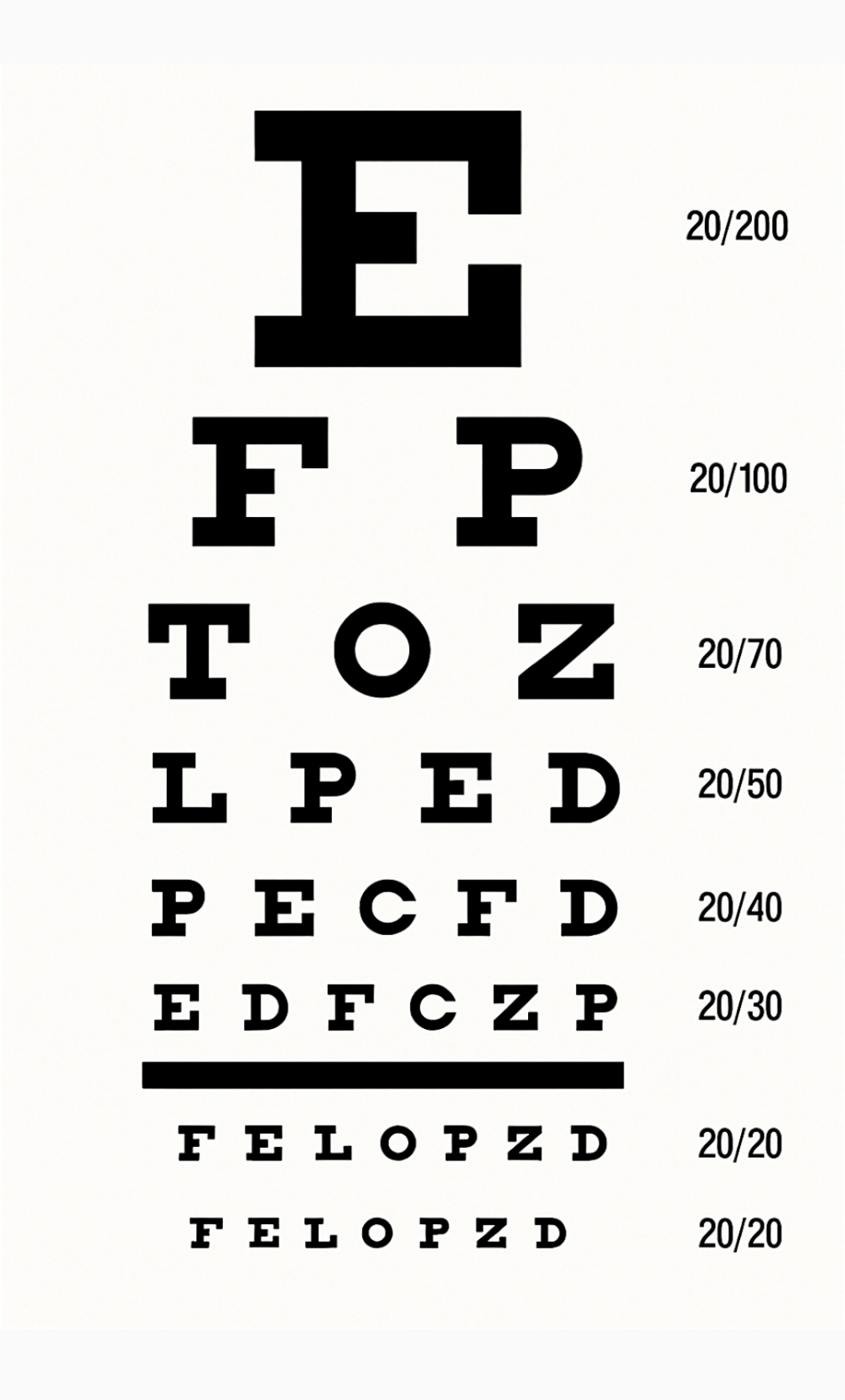
A Detailed Evaluation of the Snellen Eye Test Chart

The concept of "20/20 vision" often causes confusion. Many people first encounter it during an eye exam, staring at a bright chart with a big “E” on top. That chart is the Snellen Eye Test Chart, a standard tool for measuring visual acuity that has been in use since 1862.

Let’s take a closer look at what the test really measures and how it works.

What is Visual Acuity?

Visual acuity is a measure of the clarity and sharpness of your vision. It evaluates how well your eyes can distinguish shapes and details from a specific distance. During an eye test, you’re asked to identify the smallest line of letters you can read clearly — that’s your visual acuity.

The Man Behind the Chart

The Snellen chart was developed in 1862 by Dutch ophthalmologist Dr. Herman Snellen. Before that, there was no standardized method to test vision, and charts varied in style and size.

Dr. Snellen designed special characters called optotypes — typically letters like C, D, E, F, L, O, P, T, and Z — crafted to be seen at specific distances by someone with normal vision.

How is the Snellen Test Performed?

The Snellen test process has remained largely unchanged for over a century:

  • The chart is placed 20 feet away from where you’re standing or sitting. If space is limited, mirrors may be used.
  • You’ll be asked to cover one eye using an occluder or your hand.
  • Reading the Chart: You read the letters from top to bottom, line by line. Each line has smaller letters than the one before.
  • Stopping Point: When you can no longer correctly identify the majority of letters on a line, that’s where the test stops for that eye.
  • The test is repeated for the other eye.

Understanding the Results: What Does 20/20 Mean?

Snellen test results are written as a fraction like 20/20. Here’s what the numbers mean:

  • Top Number (20): The distance (in feet) between you and the chart.
  • Bottom Number: The distance at which a person with normal vision can read that same line.
Examples:
  • 20/20 Vision: You can read at 20 feet what a person with normal vision reads at 20 feet. This is considered normal vision.
  • 20/40 Vision: You can read at 20 feet what a person with normal vision can read at 40 feet. Your vision is below average.
  • 20/200 Vision: This is the threshold for legal blindness in many places, even with glasses or contacts.
  • 20/15 Vision: Better than normal. You see at 20 feet what others see clearly only at 15 feet.

In countries using the metric system, 6/6 is the equivalent of 20/20 vision, as the test is performed at 6 meters instead of 20 feet.

Conclusion

The Snellen Eye Test Chart remains a cornerstone in eye care. It’s simple, effective, and helps detect vision problems early. Knowing your visual acuity can be the first step toward clearer sight and better eye health.

Taking Temperature, Pulse, and Respiration: Step-by-Step Guide

How to Take Temperature, Pulse, and Respiration: A Guide for Community Health Workers

This guide provides a clear and accurate step-by-step procedure for Community Health Workers to follow when performing basic patient assessments. Each step is important for ensuring proper care and accurate data collection.

1. Explanation of Purpose and Procedure (2 marks)

Start by greeting the patient politely. Explain your actions using simple language such as: “The assessment of your body functions will include checking your temperature and pulse as well as your breathing rate.” This helps build trust and calms the patient.

2. Hand Washing with Soap, Water, and Proper Hand Drying (1 mark)

Wash your hands thoroughly with soap and clean water for at least 20 seconds. Scrub all areas including palms, back of hands, between fingers, and nails. Rinse and dry with a clean towel or allow hands to air dry. This reduces the spread of infection.

3. Assemble the Required Instruments (2 marks)

Collect the following items:

  • Thermometer (digital or mercury)
  • Stopwatch or watch with second hand
  • Antiseptic cotton swab or gauze
  • Recording sheet and pen
Arrange them neatly on a clean surface before beginning.

4. Preparation of Thermometer and Correct Insertion (2 marks)

Shake a mercury thermometer to below 35°C. Insert appropriately:

  • Oral: Under the tongue.
  • Axillary: Place in the armpit and close the arm tightly.
Leave in position for 3–5 minutes unless using a digital thermometer.

5. Counting and Recording of Respiration (2 marks)

Without informing the patient, observe chest movements for one full minute. Count the number of breaths and record it. Normal adult range: 12–20 breaths per minute.

6. Counting and Recording of Pulse (2 marks)

Use your index and middle finger to feel the radial pulse on the wrist. Count for 60 seconds or 30 seconds and multiply by 2. Record rate, rhythm, and strength. Normal adult pulse: 60–100 beats per minute.

7. Remove and Clean Thermometer with Wet Swab (2 marks)

Clean the thermometer using a cotton swab or gauze soaked in antiseptic or 70% alcohol. Wipe from the bulb (tip) to the stem to avoid cross-contamination.

8. Reading and Recording of Temperature (3 marks)

Hold the thermometer at eye level and rotate it to see the mercury line. Read and record the temperature accurately. Normal oral temperature: 36.5°C to 37.5°C.

9. Clean and Shake Down Thermometer and Replace It in Container (2 marks)

After use, clean the thermometer again if needed. Shake it down below 35°C and return it to its container.

10. Interpretation and Follow-Up Instruction (2 marks)

Check the readings for abnormalities. Report any abnormal temperature, pulse, or respiration rate to a supervising nurse or health professional. Inform the patient of the next steps, for example: “Your temperature is a bit high. We’ll let the nurse know so she can assess you further.”